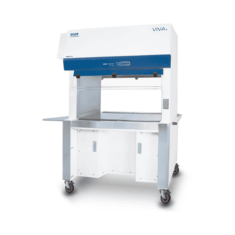
Dual Access Animal Containment Workstations
Dual Access Animal Containment Workstations are engineered to provide advanced clean air performance for vivarium and animal research environments. These systems help protect investigators and animal care personnel from exposure to animals, bedding, dander, and other airborne particulates that may contribute to occupational health concerns such as allergies and asthma.
Designed for cage changing, animal handling, and procedural workflows, dual-access workstations deliver balanced protection for personnel, animals, and the laboratory environment.
Triple-Layer Protection: Operator, Animal & Environment
Dual access systems are designed to create a controlled airflow barrier that supports:
Operator Protection
- Reduces exposure to airborne allergens and particulate matter
- Directs airflow away from the breathing zone
- Captures contaminants during cage changing and handling procedures
Product & Animal Protection
- Maintains a clean work zone to reduce risk of cross-contamination
- Helps protect animals and research materials from external contaminants
- Supports aseptic technique during sensitive procedures
Environmental Protection
- Minimizes allergen and particulate release into the surrounding laboratory
- Helps maintain cleaner vivarium air quality
- Supports institutional occupational health programs
This multi-directional containment approach makes dual-access systems particularly valuable in high-volume cage changing rooms and research facilities with strict exposure control protocols.
Controlled Airflow & Filtration Performance
While configurations vary by manufacturer, dual-access containment workstations commonly include:
- HEPA or ULPA filtration for high-efficiency particulate capture
- Vertical laminar airflow or balanced airflow designs
- Recirculating or externally exhausted airflow options
- Clear viewing panels for visibility and workflow coordination
- Dual-sided access for team-based procedures
By creating a contained, filtered airflow envelope, these systems help facilities align with guidance from organizations such as AAALAC International and occupational health recommendations commonly referenced by the National Institutes of Health.
Designed for Cage Changing & Procedure Efficiency
Dual access workstations are commonly used for:
- Rodent cage changing
- Animal transfers
- Small animal procedures
- Bedding replacement
- Quarantine workflows
Dual-sided access allows two operators to work simultaneously while maintaining containment integrity, improving throughput in busy vivarium environments.
Ergonomics & Facility Integration
Modern dual access workstations often include:
- Ergonomic work heights
- Clear sightlines for safe animal handling
- Energy-efficient blower systems
- Easy-to-clean interior surfaces
- Mobility options or fixed installation configurations
These features support long-term durability and help reduce operator fatigue during repetitive workflows.
Why Choose Geneva Scientific?
Geneva Scientific supports vivarium facilities with:
- Application-based equipment matching
- Comparative guidance across manufacturers
- Assistance with airflow configuration (recirculating vs. exhausted)
- Support for new construction and renovation projects
- Fast, responsive quoting
We understand that proper containment equipment plays a critical role in protecting personnel, maintaining animal health, and preserving research integrity.
Request Specifications & Pricing
If your facility is upgrading cage change procedures or expanding vivarium capacity, contact Geneva Scientific for detailed specifications, airflow configuration guidance, and a competitive quotation.
Dual Access Animal Containment Workstations provide a balanced solution for investigator safety, animal protection, and environmental containment — all within a single integrated system.