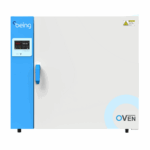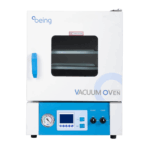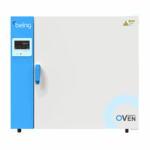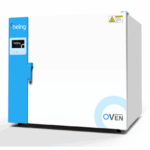
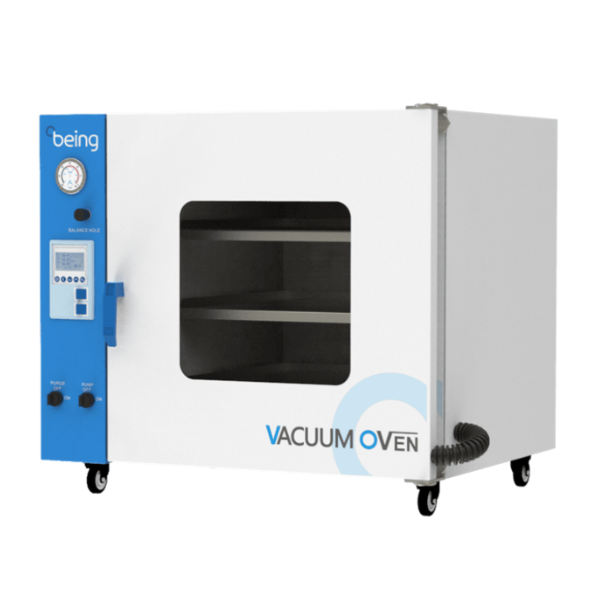
Being Scientific Model BOV-120 Laboratory Vacuum Oven
Compact Vacuum Drying Oven for Controlled Atmosphere Applications
The Being Scientific BOV-120 Vacuum Oven provides precise thermal processing in a controlled vacuum or inert gas environment, making it ideal for oxidation-sensitive samples, contaminant removal, and accelerated outgassing. Its airtight chamber allows for accurate vacuum levels to be maintained via an external pump, providing safe and efficient drying or curing of sensitive materials.
Designed for chemical, pharmaceutical, electronics, and materials research laboratories, the BOV-120 offers precision, reliability, and versatility in a compact footprint, perfect for labs with limited space.
Key Benefits
Precision & Control
- Vacuum range: 0 – 0.1 MPa (limit 133 Pa) for sensitive low-pressure applications
- Inert gas interface enables the use of nitrogen or other gases to prevent oxidation
- Temperature deviation alarm ensures sample integrity
- 4-sided jacket heating delivers uniform temperature throughout the chamber
Durable & Safe Design
- Corrosion-resistant mirror stainless steel chamber
- Built-in toughened glass door allows for safe observation of samples
- LED lighting illuminates the interior for easy monitoring
Convenience & Usability
- External dimensions: 31.9 × 25.4 × 28.9″
- Internal chamber dimensions: 19.7 × 19.5 × 19.5″
- Chamber capacity: 4.4 cu ft (125 L)
- Temperature range: Ambient +5°C to 200°C
- Electrical: 110V, 1450W, Plug Type: NEMA 5-15
Applications
- Oxidation-sensitive sample drying in chemical or pharmaceutical research
- Contaminant removal from lubricants, solvents, or specialty materials
- Accelerated outgassing for polymers, composites, or electronics components
- Controlled atmosphere processes with inert gas introduction
Why Choose the BOV-120
The BOV-120 combines compact design, reliable vacuum control, and uniform heating, making it ideal for laboratories that need precision vacuum drying without sacrificing space or safety. Its versatile inert gas compatibility ensures minimal surface reactions while maintaining sample integrity during processing.